.jpg)

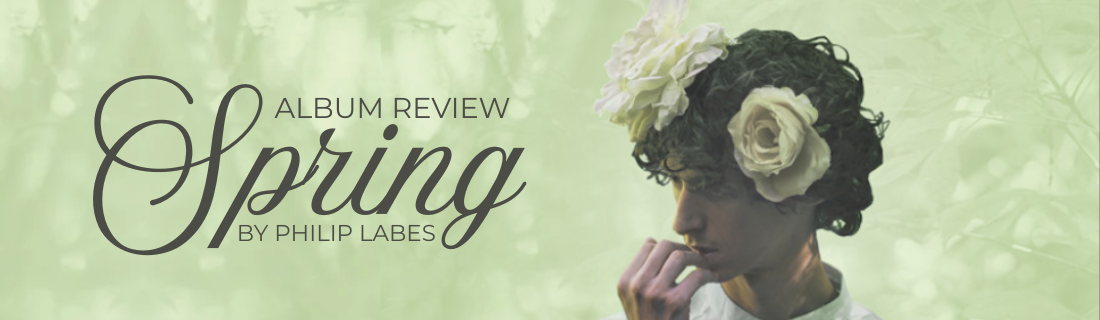
How wonderful it is to find artists who fully leverage the album as a medium! Albums are capable of transcending being a mere arbitrary collection of songs: curation imbues artistic meaning via a throughline that lets each track bounce off the others and compound meaning. If every song says something substantial, you should, in theory, get a no-skip album.
Philip Labes’s Seasons project is that accomplishment on four times the scale: one album per season, all released within a year, each embodying its season’s emotions and associations, delegating each album its own musical style. Now, that’s range.
I’ve looked up to Labes for the longest time, and Seasons was so rich a joy that I can’t help but pick it apart. Covering all four albums here would be folly, so I’ll focus on the first: Spring.
Introduction
Here’s the project’s premise: Seasons as a title signal time’s passage, and with it, the coexistence of growth and cycles. Beginning with Spring suggests a recent winter – recovery from grief, perhaps? Across all four albums, Seasons promises that we can weather life’s woes, with Spring serving as its microcosm.
There’s also the ‘stages of grief’ lens: Spring as denial, Summer as anger, Autumn as bargaining, Winter as depression, each facilitating mini-arcs toward acceptance. Denial fits Spring beautifully: rebirth, innocence, immaturity…
Of course, it would be remiss not to mention Vivaldi’s Four Seasons, whose first Spring sonnet proves illuminating:
Thunderstorms, those heralds of Spring, roar, casting their dark mantle over heaven,
Then they die away to silence, and the birds take up their charming songs once more.
Apt, of both album and project: no matter how dire things become, there will always come another spring.
The Review Proper
I. Exposition: Rebirth
1) I’ll Never Be Sad Again
I’ll Never Be Sad Again is a wonderfully conflicting opener. On one hand, I’d love to believe the persona’s fantasies:
Finally, I’ll put my beating heart inside another person’s hands.
On the other: what kind of promise is one to never be sad again? Having endured some rough patches, he copes by denying even the possibility of future downturns:
Throw out the violin,
I’ll never be sad again.
The violin, representing Vivaldi’s body of work, is a neat symbol: discarding it means preemptively denying the seasons to come. The lesson ought not to be that the sun will never set again, but to weather it when it does and await its next rise.
Musically, Labes sells this tension through jolly, striding guitar and busy acoustic textures, all undercut by sudden quiet and harsh drum hits after the persona’s more worrying proclamations – warnings or distractions, who’s to say?
Even the rhyme schemes feel intentional: ABAB sections are more candid, while ABACCB sections delay resolution as he dances around how he feels.
2) Springtime
Springtime is one of the most hopeful songs I’ve ever heard: the kind that leaves your heart willing to afford a little fragility. Its cheering, momentum, and rapid swells are naught but magical; where the opener carried conviction, this carries wild faith.
Yet the hope remains unsustainable – the track literally ends with hysterical laughter. It also begins the persona’s habit of mythologising turmoil, relaying more than digesting it. Here, through Greek myth:
Ares was far too mighty, abandoned by Aphrodite.
My psyche was falling apart.
Ares suggests conflict; Aphrodite, love, leaving his life; Psyche, both mental state and mythic lover chasing Eros – desire – while tormented by Aphrodite.
So, ah… we’ve got a romance-gone-awry on our hands.
II. Metaphorising as Tentative Emotional Processing
3) A TV Show Called Earth – Acoustic
A TV Show Called Earth is an extended metaphor allegorising political commentary and existentialism into a cute aliens-subscribed-to-streaming scenario. The stripped-back instrumentation – lone guitar plucks – is pacifyingly entrancing in how twinkly it sounds, too.
The persona’s metaphorising has somewhat improved: dressing existential dread up as cutesy suggests he’s still avoiding its full weight, but at least he’s thinking.
Until the very last one of us was gone,
And one turns to the other with a clicker in his hand and says,
‘That was fun, let’s see what else is on.’
And, I have to say, the metaphor runs incredibly tight, especially with the sociopolitical commentary:
Recently, they trashed the set to make a couple bucks.
And a plot like that has not been seen before.
They might only have a couple seasons more.
4) Bachelor’s Degree
Bachelor’s Degree confronts the immaturity that comes with the youth of rebirth. It analogises a romantic relationship to a Bachelor’s – after clocking 10,000 hours, you’ve learnt all there is to learn, and it’s time to be bad at someone new. Musically, it’s the spunkiest one of the bunch, underpinning the persona’s unwise flippancy. Rest assured, though: he’ll learn his lesson very, very soon.
III. Awakening
5) Reasons To Never Date Again
The persona’s romantic karma, in which he’s stood up for every stereotypical reason under the sun. It’s chock-full of brutally hilarious disappointment, executed excellently through Labes’ frenzied delivery and arrangement choices – “songs that get frantically faster as they go” is a genre that never gets old.
The narrative purpose of this track, though, is to slap the persona out of his naivete and immaturity. Judging from what follows, it appears to have worked.
6) Just Another Day
In the smack-dab middle of the album, the persona finally quits dressing his thoughts up – whether as cutesy, all-positive, or with removed metaphorical layers. None are to be found in this track. He recognises his life’s banality for what it is:
I know life’s supposed to be special, but it’s just another day.
And, unlike earlier in A TV Show, he now faces existentialism candidly:
When death comes knocking at my door,
She’ll find me in my room, folding clothes into a drawer.
Here’s emotional lucidity. It’s also evidenced from the fact that, from here on out, the persona no longer employs metaphors to superficialise his thoughts, but to deepen them.
Also, Labes’ lyrics are killer here. This work might be one of his strongest; tinkering with compound words and internal rhymes will do that for you. I’d quote some again, but I truly believe this is best proven by a listen of your own (or by clicking the embed above).
IV. Metaphorising as Deliberate Emotional Processing
7) Jeff Found a Genie
Our second round at political critique, and it’s, shall we say, infinitely more blatant with what it’s trying to say:
Yeah, let’s hear it for Jeff, who’s got everything,
Every single f****** thing except a heart.
It appears the persona’s awakening has left him much more in tune with, and candid about, his emotions. I also find it neat that we get a spark of anger – the second stage of grief – now that he’s overcome denial, even as we’ve yet to settle into short-lived acceptance.
Compared with A TV Show, it might be significant that these are the most instrumentally similar, as it spotlights their differences: A TV Show is pacifying, while Jeff Found A Genie twists the knife. Labes’ anger is palpable and contagious; it’s no wonder this is the album’s most-streamed song.
8) Blank Spot
This is the track reassuring you that the persona’s using his allegories to process his feelings, not cover them up. Metaphors are transparent, rather than evasive:
There’s a cavern you used to live in, shining light inside of me.
And he can still pull himself out of it and say things straight:
But I’ll work the day away, pretend that I’m okay, eat salads, and lift weights.
Goodbye, denial! I also have to commend the composition for how it makes good, idiomatic use of its two vocalists: Klug’s bracketed echoes sell the feeling of two voices in your head willing opposite things, perfectly encapsulating the dull anguish and turmoil of the predicament:
Don’t call me… Call me when you get there.
Don’t let me (let me) let me let you go.
V. Contentment, or Peace, or Acceptance
9) Cafe La Rue
This is the most distinctly, fantastically fictional track on the entire album, which begs the question: what is it doing here?
It puts forth the scenario wherein one is able to ‘order’ the life they’d like, akin to perusing a menu. Once again, the metaphor is run as tight as the Navy:
So if spice is a price you’re willing to bear, it pairs awfully well with a saucy affair.
Thanks to the production and vocals, this song sounds straight out of a musical. Labes’ dramatic enunciation and arrangement choices – waltz gait, fluttering woodwinds, honky tonk keys, backup-like vocals, maniacal laughter – are all very whimsically fantastical. Still, one wonders what it’s doing in an album that’s so grounded the rest of the time.
If ever you thought that your life had picked you,
Remember, you once sat at Cafe La Rue.
Obviously untrue. We could argue free will in individual choice, but overall life trajectory? Really?
I suspect the irony of the falsehood re-emphasises our confinement to our lot, which is material that the next track is able to respond to, almost as a foil:
10) Mr. Shoes Tied
From here on out, the lyrics are devoid of abstraction. The persona sets it all straight:
I thought that I’d be a millionaire. I thought I’d be in Vanity Fair.
But I’m gonna be thirty, my kitchen is dirty, my shower drain is clogged with my hair.
But more importantly:
I’m Mr. Shoes Tied, Mr. Deep Sigh, Mr. I’m Doing Alright.
I’m Mr. Hindsight, Mr. Fine Life, Mr. Peaked In Junior High.
I used to think I’d be the man, but now I think I’m just some guy.
F*** it, I love it!
I’m not a prodigy waiting to be alive.
Sorry for quoting so much, but everything this song says is right there on the tin! After Cafe La Rue, it shows that the persona did not choose this trajectory, yet embraces his unremarkability. His naive aspirations do not come true, nor does he deny life’s shortcomings. Still, he takes life by the hand in stride.
The persona’s growth, I think, is best encapsulated in the album’s final track…
11) Hanging In & Hanging Out
It’s really neat that the first, middle, and final tracks grant us snapshots into the persona’s day-to-day life. It’s a great demarcator of the growth he’s exhibited over the span of eleven songs:
Pressing all my clothes in origami folds.
We have seen mundanity before – I’ll Never Be Sad Again was flippant; Just Another Day was disenchanted. Here, the jolly swing groove, cute instrumentation, and cheery vocals celebrate the current stage. Crucially, he is not pretending his way out of sadness again:
So I have my daily cry, and I bake a pumpkin pie.
Money I can pay to make sadness go away, but if I can’t be happy, maybe I can be okay.
I can see clearly now, I’m okay! And I wouldn’t have it any other way!
Just as long as I can choose to stick around,
I’m just Hanging In & Hanging Out!
It’s a fitting conclusion to Spring and a microcosm of Seasons: there are both good and bad times ahead, but we hope that the promise of a future sunrise overpowers the dread of a future night. The persona hasn’t quite gone back on his promise to never be sad again, but he’s at least conscious and open about the fact that he cannot be happy all the time, and that this is something we can more than live with. It’s progress!
Of course, Summer imminently arrives, heralded by the UN climate report recording in the track: anger now waits where denial once stood.
Conclusion
Thank you for making it all the way! Labes’ Seasons project is one that I muse about a lot, so this review has been a form of catharsis, in a way.
Ultimately, I’m a staunch believer in music’s literary merit as a medium, lyrical or otherwise – especially with all the hidden potential that lies in its aural artillery. Spring is a perfect example of why I love writing reviews such as these – I get to revel in that my ear will never go hungry!
You can find Philip Labes on his website, Spotify, Instagram, and TikTok.



Login or register to join the conversation.
Join the discussion
0 comments