.jpg)

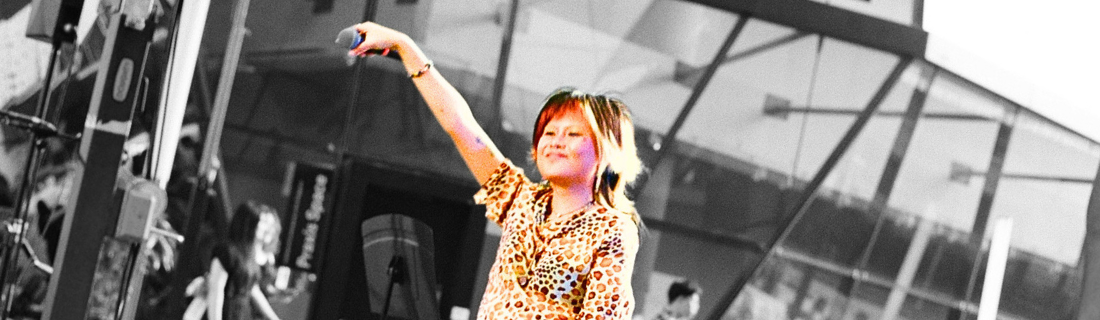
Singaporean-Filipino independent artist Marian Carmel exists between genres and countries. Yet, even as I hit 'shuffle' on her Spotify all the way back in February, each song threaded a common needle of unflinching authenticity and earnestness that told me the same artist wrote and performed all these songs across acoustic indie, romantic pop, and even soft rock.
IAAS Music had the pleasure of sitting down with them for a chat after her set at LASALLE's Rock and Indie Festival 2026. And boy, what a great set it was! Audience interaction, comedy, music in not one, but two languages – Marian Carmel had it all, and we covered it right here in our Day 1 recap.
I think there's something for everyone here. Music enthusiasts, fellow artists, and songwriters alike will find some golden insights in how Marian's spaces affect her craft, how they approach collaborations within and outside the country, and more. There's just so much to take away here today... and so, without further ado, I'll let Marian tell you all about it in her own words.
IAAS Music: I think my first question is something that I thought was really interesting about your bio. And that's growing up between the Philippines and Singapore. How have those countries influenced your sound and that sense of sound in your life?
Oh my god. This is the question – I love that.
For the longest time, my music journey started here from when I was 19, joining Noise. I made my way back for my first Philippines tour in 2022, but prior to that, I had been schooling for most of my life here.
So just to backtrack, I moved here when I was 5 for kindergarten and second year of grade school. And then I moved back to the Philippines. Then I moved back here again for secondary school until now. So most of my life has been here, and I think my musical identity was kind of formed here.
As I learned more about myself I think I kind of grew alongside my music. I wanted to like connect more with my roots, I suppose, because at home we still speak Tagalog and everything. So i don't think I ever really left.
I wouldn't say that I'm more of [one] or the other, you know, I'm very equally both. I've spent so much time here, that I also want to be able to do the same in the Philippines. Growing up here, I think, as someone who is a third-culture kid, queer, and brown, I've always felt some some form of othered. I mean, literally in your NRIC [National Registration Identification Card], it says 'other' when you're Filipino. Because it's CMIO [the racial identification system in Singapore, of which the options are Chinese, Malay, Indian, or other], right?
So, when I went on tour in the Philippines in 2022, I was like, holy crap, there's a different sense of belonging, I guess, and home. Not that I don't feel like I belong here, I mean. I feel like there are so many amazing pockets of community, especially at the shows. You get to see people who kind of look similar in the crowd.
Going back, I was like, oh wow, this is a part of me that I don't get to explore and experience while I'm here and while I'm schooling. So I made more of an effort in the last few years. I actually just came back from the Philippines.
I do a tour there yearly as much as I can. Actually, I started in 2022 and then 2024 – I skipped 2023.
And I realised as I get older too, like now that I have a frontal lobe, it's been really nice to write about things that aren't relationships and love. Because I wrote a lot about that – you know you've seen the set – and that's what is released at the moment.
But now that I'm in a a long-term relationship, like, I can't complain anymore. Like, I'm out of things to complain about because I'm happy – it's the end of a songwriter's career when you get in a happy relationship. So I was like, what else can I complain about?
And I was like, oh! So now I write a lot about identity as a third culture kid, as someone who is queer, and lived experiences here as well.
So yeah, I think the place really does impact what I write about. Like another song that I wrote recently was about the recent typhoon in the Philippines. My family is there and I'm the only one who's in Singapore. There's a sense of hopelessness and death where you're... you know, it's so comfy here and it's so safe, but I don't even know if my family is going to survive.
It's... it's really real, and so those are the kind of things that I'm writing now. A lot about the idea of home, and multiple homes, too.
I feel that... It's tough to be away from home even on the best of days.
I noticed you've released songs with Tagalog, as well. Do you tend to write those in the Philippines, given that the place affects what you write? How do you find it different from writing in English?
Personally, I'd love to write in my second language, but I'm not sure I'm good enough with it.
You know, I used to think I wasn't good enough at it either. But it's just practice, especially because I don't think I wield Tagalog in the same poetic way as I do English. You never know – it's like unlocking a new door, because in another language the syntax and structure, it's all different.
I feel like when I sing, it also resonates in a different part of my body when it comes out. So it's always nice to explore different languages.
Most of my songs are written right here [in Singapore], because I'm based here most of the time. [The most recent Tagalog track] wanted you is on my second EP, what if nobody kisses me?.
Just nice, because the next question I'm asking is about that EP – your most recent!
I noticed you have a lot of collaboration in your discography, and you feature a lot on other artists' work. What's your collaborative process like, from the idea to the final mix? Since I noticed that you also work with a producer, so there's another collaboration there.
Usually, it depends on who I'm collaborating with. Between me and my producer, because we do everything together, it's either I have an idea or I'm going through it. I write a song with my guitar, record on Voice Memos or make a quick demo, then I send it to him. And then he builds a world out of that – I see it as me giving him a mannequin, and him dressing it up.
He's based in Paris – he was actually a LASALLE student. We graduate in the same year, but he had to move back to Paris and we do everything online. So we have weekly calls most of the time, it's quite consistent. And then we can talk about "what's the vibe" or anything like that. Is she grungy, is she Y2K, and then we design the outfit together. Sometimes the outfit comes first, and then I build the mannequin after.
In terms of collaborations with other artists, I think it's really awesome. Like with music in Singapore, because the scene is so small, you can just shoot a DM to an artist and be like, "Hey, wanna write a song together?"
There's always no strings attached too, right... You write something, and if you both like it, then you release it. If you don't, it's okay, it's a song and there's always a chance to play. Most of the time, I do get to release them, and it's been really fun doing that! I love being able to put myself in the situation of another person.
As much as possible, I do it face to face. There's nothing like being in the same room and feeling the energy together and passing the ball around... It's play, you know? Sometimes when you do it online, it's like, can you hear me?. There's so many logistics involved, and it breaks the flow – but sometimes that's all you have.
Similar to your most recent feature The Van Song with Aaron Bunac, if I recall correctly?
Yeah! He had lived in a van with his wife for two years, and I was like, "Oh my God, let's write about that!" Like, let's write about your experience – how did you feel, would you do it again, and... Yeah, like being in a shared space with your loved one for two years. It's a challenge, but you'd still do it because it's with someone you care about, you know. Lots of yapping, talking about the experience, and seeing what comes out of it together.
You've definitely crossed a lot of genres! Your collaboration Parachuting Off The Moon (with RENE, barb) is very rock, what if nobody kisses me? is romantic pop, the next song is lofi, and Utopia Reimagined: Parallel Lines is very acoustic pop. How do you explore these artistically with each release while managing your brand and audience?
It really does change. I feel like at the core of it, I'm just a songwriter – whatever shape the song might take is up to the song. That sounds so woo-woo, but you know what I mean.
If it feels like it's going to be an acoustic song, then I'm not going to force it to be something else, just because that's my branding. So, I feel like it is quite confusing for a lot of people, but I'm the kind of artist has been doing it for a while now. I have evolved alongside my music, and I also do get bored. It's like changing a hairstyle – if I want to try something different, I will do that.
I feel like at the end of it, it all kind of belongs under the broader umbrella of indie pop.
As an emerging artist, do you face any particular challenges navigating the music seen in Singapore, and how do you work past that?
I would say the main challenge is that [there are strict rules on public performance in Singapore]. And it's tough, when the systems around you are in such a way you can't help but self-censor sometimes. I try not do do that, but you know, it's just kind of subconscious.
I'd say, you make your own community. The reason why I keep on doing this anyway, despite it being hard, is because I want there to be representation for people like me. It's important – if nobody else sees that we're doing well out there, then it's tough to feel like things are going to be okay... Joy and resistance is my whole shtick.
This kind of ties into my other question, then. Do you have any words of advice for South-East Asian artists, from your career thus far?
This is something that's been passed down to me, when I asked Nay Palm – the vocalist of Hiatus Coyote – when I was first starting out 10-11 years ago, "What is a piece of advice that you would give an aspiring musician?"
And what she told me was, "Make the music you want to hear in the world, not what you think the world wants to hear." And that has stuck with me – that is my guiding light, my North Star. Up to this day, I would feel, I've made music I want to hear in the world.
I think that's what's important – like, you never know who's going to hear it. And I think music is for connection, at the end of it. And yeah, there's something special about hearing this song that you feel is specifically written for you. It's feeling seen, and being seen, also – it goes both ways.
Last question – can you recommend me one OPM [Original Pinoy/Pilipino Music, referring to any contemporary popular song from the Philippines] song that you've been listening to?
Oh my god!
You can give me more than one, don't worry. Local Singaporean music is fine too!
There's one that just released today, Labs Kita by Shanne Dandan. Very awesome – the music she makes is very old-Manila sound, her inspirations are from the 70s and 80s. And she brings that to now! It's really cool, if you hear it, you'll be like, Oh my god, I'm in the streets of Manila, you know, there's wind, there's grass... and it's just nice and very sweet.
For local [Singaporean] music, Then There's You by Rene and lewloh. I thought that was so good, I really love that... It brings me to tears. It's made so well, and with so much heart. I know RENE took three years to rewrite that over and over again, but it is so good.
It's about the moon and ocean singing to each other, because you know how the tides are always reaching toward the moon... It's like, yearning. I would cry just thinking about it.
Great recommendations! I'm definitely going home to check those out, and I'm sure our readers at IAAS will be too. Thank you so much for the interview, and the wonderful show earlier!



Login or register to join the conversation.
Join the discussion
0 comments